
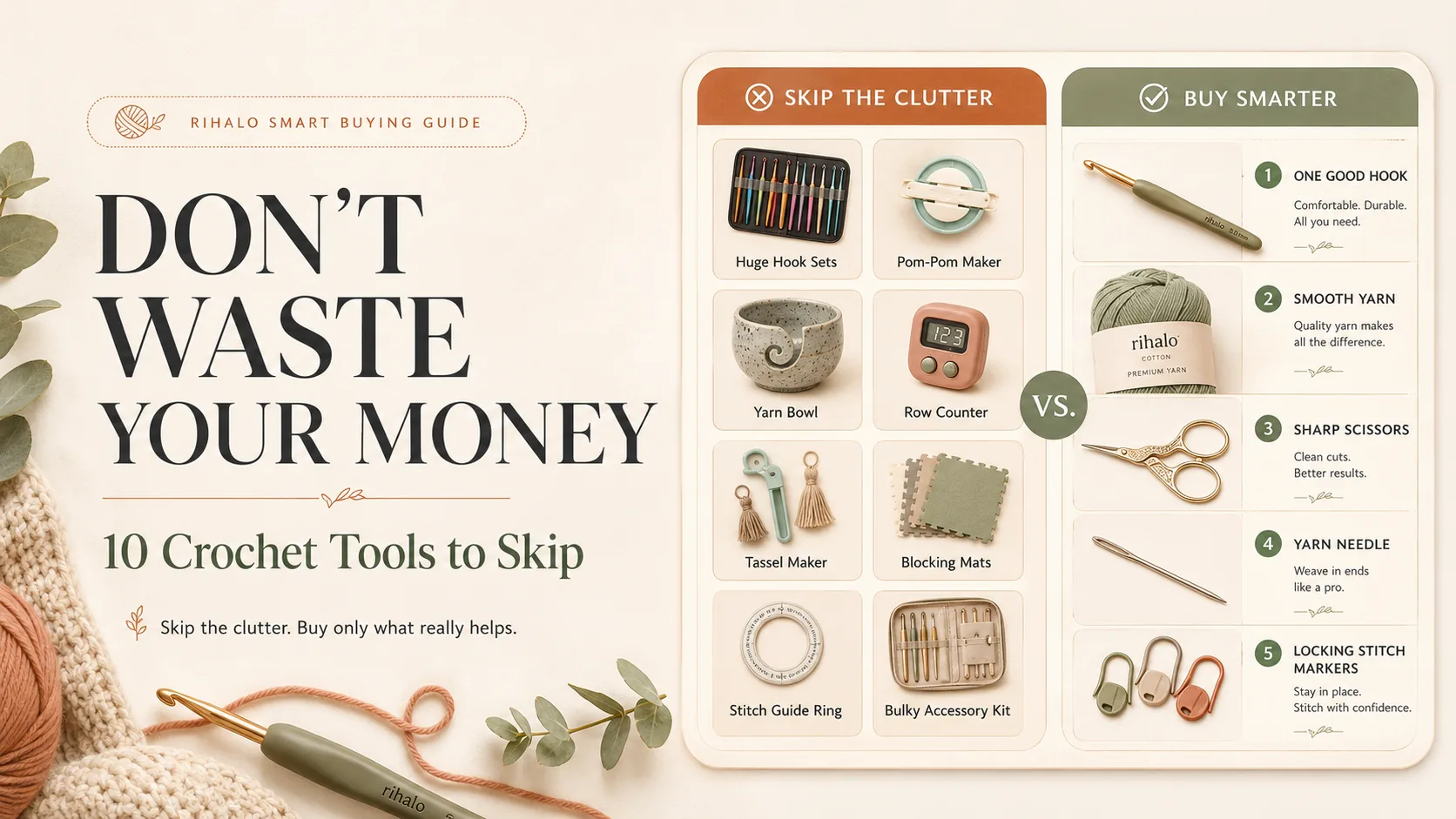
10 Crochet Tools You Don’t Actually Need — And What to Buy Instead
10 Crochet Tools You Don’t Actually Need — And What to Buy Instead
Skip the clutter. Here’s what beginners can save their money on—and the few crochet tools actually worth buying.
You do not need a 50-piece crochet kit. Start with one comfortable hook, smooth yarn, scissors, a yarn needle and a few locking stitch markers. Add everything else only when it solves a real problem.
The Small Crochet Kit We’d Build First
Crochet requires far less equipment than product listings can make it seem.
One precise pair is more useful than a bulky multi-pack. These compact micro-tip scissors are a practical choice for clean yarn cuts and detailed craft work.
Check it on Amazon →Huge Crochet Hook Sets
A case filled with twenty or thirty hooks looks like incredible value. The problem? Many beginners use only a few sizes for months.
Your project and yarn determine the hook you need. More importantly, you may later discover that you prefer ergonomic handles, inline heads, tapered hooks, bamboo, aluminum or a completely different handle length.
Affiliate disclosure: As an Amazon Associate I earn from qualifying purchases.
A comfortable individual hook is a smarter starting point than buying a large set before you know which sizes and handle styles you prefer.
Check it on Amazon →Fancy Yarn Bowls
A handmade wooden or ceramic yarn bowl can make a crochet desk look beautiful. But its basic job is surprisingly simple: stop your yarn from rolling away.
If your yarn already stays beside you without disappearing under furniture, you may not have a problem that needs solving.
Mechanical Row Counters
Row counters can be useful for long repetitive projects—but many beginners buy them before they know whether row counting is even a real problem for them.
For a small practice swatch or beginner washcloth, a simple tally on paper can work just as well.
Expensive Tension Rings
Tension rings are often marketed as an instant solution to uneven crochet. They can help some people guide yarn—but they are not a shortcut to consistent tension.
Tension improves through repetition, hand position and learning how a particular yarn behaves.
Giant “59-Piece” Beginner Kits
This is one of the easiest beginner purchases to overvalue because the product photo looks spectacular.
The number of pieces tells you almost nothing about quality. A kit can inflate its item count with duplicated accessories, dozens of markers, cheap needles and hook sizes you may never use.
Meanwhile, the tool you actually hold for hours—the hook—may be mediocre.
A smaller kit with tools you understand and enjoy using is more valuable than a case full of accessories you cannot yet name.
Dedicated “Crochet” Scissors
Tiny embroidery scissors look beautiful in photographs. They also cut yarn. But so do many scissors you probably already own.
You do not need scissors marketed specifically for crochet to begin.
Blocking Mats for Your First Project
Blocking can dramatically improve some crochet projects, but your first practice swatch does not require a professional blocking station.
Dedicated mats become much more valuable once you make granny squares, lace, garments or motifs that need consistent dimensions.
A Yarn Winder Before You Need One
Yarn winders can be incredibly satisfying and genuinely useful. That still does not mean every beginner needs one.
If you own only a few ready-to-use skeins, a winder may spend more time in a drawer than on your desk.
A Dedicated Gauge Ruler
Gauge matters enormously when fit and dimensions matter. A specialized gauge ruler, however, is primarily a convenience.
A normal ruler or measuring tape can measure the same swatch.
Expensive Project Bags
A good project bag is genuinely convenient—but you do not need a specialized bag before finishing your first project.
Your first few projects can live perfectly happily in a clean tote, zippered pouch, reusable bag or small basket.
Locking Stitch Markers Are Surprisingly Useful
One of the hardest early crochet skills is recognizing exactly where a row or round begins and ends.
A locking marker can identify your first stitch, last stitch, beginning of a round, increase point, decrease point or pattern repeat.
You can improvise with scrap yarn, but proper locking markers are inexpensive and convenient.
If your flat crochet mysteriously keeps getting wider or narrower, mark the first and last stitch of every row before buying another gadget.
Twenty locking markers are enough for most everyday crochet projects without filling your kit with a bulky box of accessories you may rarely use.
Check it on Amazon →What About Ergonomic Crochet Hooks?
A basic hook can produce excellent crochet. An ergonomic hook does not automatically create better stitches.
What it can change is comfort during longer sessions. Wider or shaped handles may feel significantly better for some crocheters.
Rather than immediately buying an expensive full set, compare one basic hook with one ergonomic hook.
Pay attention to grip, control, yarn glide, handle length and hook-head shape. If you clearly prefer the ergonomic version, then expand your collection.
The Crochet Kit We’d Build From Scratch
Start lean, learn what you like, then upgrade intentionally.
Bare Minimum
Enough to start learning today.
- One suitable crochet hook
- Smooth yarn
- Scissors
- Yarn needle
Smart Starter Kit
The setup we’d recommend to most beginners.
- One comfortable hook
- Beginner-friendly yarn
- Sharp scissors
- Yarn needle
- Locking stitch markers
- Measuring tape
Comfort Upgrade
Add only when your projects justify it.
- Ergonomic hook
- Project bag
- Blocking tools
- Additional hook sizes
Before You Buy Another Crochet Tool…
If you cannot name the problem, wait before buying the solution.
A normal bowl may already be your yarn bowl.
Judge purchases by your actual upcoming projects—not an imaginary future stash.
This is especially useful when trying a new hook style.
Quantity and value are not the same thing.
Build Your Kit Around Your Crochet—not Someone Else’s Shopping List
The crochet industry can sell you almost anything. That does not mean you need almost everything.
A beginner with one comfortable hook, appropriate yarn and a few simple finishing tools can learn far more than somebody with a huge kit they do not understand.
Start small. Crochet for a while. Notice what repeatedly frustrates you. Then buy the tool that removes that frustration.
Over time, every tool in your collection should earn its place.
Crochet Tools FAQ
What crochet tools does a beginner actually need?
A beginner can start with a suitable crochet hook, smooth yarn, scissors and a yarn needle. Locking stitch markers are also extremely useful.
Do beginners need a full crochet hook set?
No. Start with the size required for your first project, then add additional hook sizes as your projects require them.
Are large crochet starter kits worth it?
Some can be good value, but judge them by the quality of the useful tools rather than the total number of pieces advertised.
Do I need a yarn bowl?
No. It is a convenience rather than an essential tool. A normal bowl, basket or project bag may work perfectly well.
Are stitch markers necessary for crochet?
Crochet is possible without them, but locking markers are especially helpful for beginners, working in rounds and identifying edge stitches.
Do beginners need blocking mats?
Usually not immediately. They become more valuable for motifs, garments, lace and projects where exact dimensions matter.
Are expensive ergonomic crochet hooks worth it?
They can be for some crocheters, particularly for comfort. Try one ergonomic hook before committing to a complete premium set.
Create Better. Buy Smarter.
Explore practical crochet guides designed to help you choose better tools, avoid unnecessary purchases and create with more confidence.
Explore Crochet Guides


One Comment